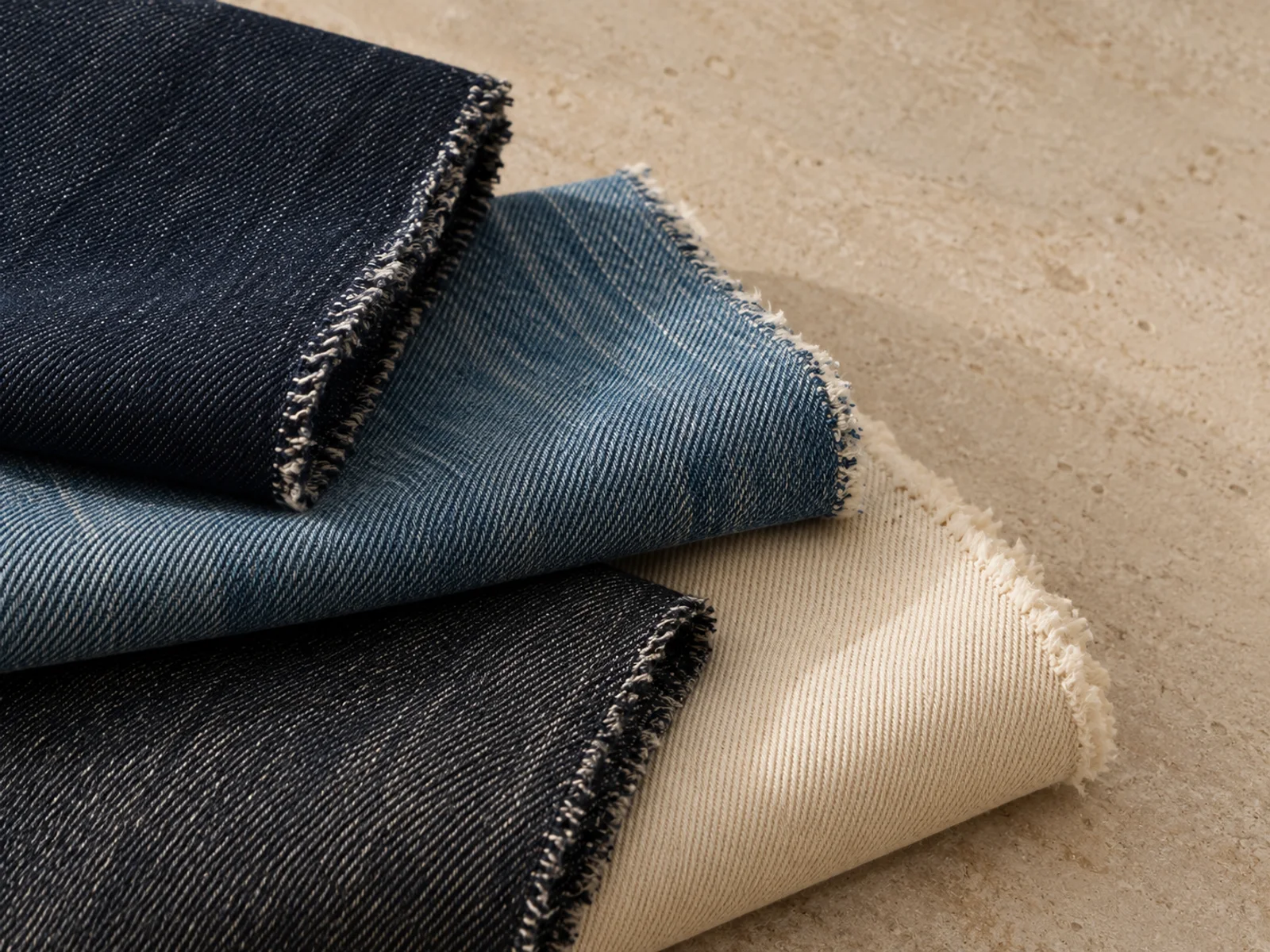
Weight is often the first specification discussed in denim sourcing. It provides a shared starting point, but a number alone cannot determine whether a material fits your product. A useful inquiry connects weight, width, composition and the condition of the reference sample.
01 / THE BUYER’S PERSPECTIVE
Start with the unit
Denim weight is commonly expressed in ounces per square yard, or oz/yd², and also in grams per square metre, or GSM. State the complete unit rather than simply asking for “12 oz” or “heavy denim.” Ask which sample condition the quoted weight refers to, so the quotation and the sample can be compared on the same basis.
02 / THE BUYER’S PERSPECTIVE
Work back from the application
Explain whether you are developing shirts, trousers, jackets or bags, then describe the intended silhouette and season. A reference swatch can communicate your intention more clearly than a weight number alone. Similar products may still need different materials: a close-to-body garment, a structured jacket and a supported bag should be discussed separately.
03 / THE BUYER’S PERSPECTIVE
Compare hand feel and structure
Review candidate samples under consistent conditions. Look at the folds, the way the fabric hangs and the layers at a proposed seam. Record whether your preference is softness, compactness or a more pronounced texture, then relate that preference to the quoted weight. Treat “heavier” as a description rather than a shortcut for quality.
04 / THE BUYER’S PERSPECTIVE
Identify the sample condition
Ask whether specifications refer to unprocessed cloth, finished fabric or a sample after a particular wash. If the garment will receive further processing, keep the original and processed samples as a pair for assessment. Record the approved sample version in the confirmation document so future decisions do not depend on memory or a photograph alone.
05 / THE BUYER’S PERSPECTIVE
Make quotations comparable
Include the application, target weight and unit, composition, usable width, estimated quantity and reference sample in the inquiry. A range is acceptable when the specification is still being explored; identify the essentials and the flexible items. Compare quotations for different material options separately instead of treating price per metre as the only decision point.
References
CottonWorks · Denim Basics ↗This journal provides material and sourcing communication guidance. Actual specifications, processing capabilities and transaction conditions are confirmed separately with the company.